Your Annual Planning Session Is Broken
A few years ago a software consultancy brought me in to facilitate their annual planning session. Two hundred and thirty employees in the Atlanta office. Fortune 500 client base.
They were not in crisis. They had not blown a quarter. The leadership team had run annual planning sessions before, multiple times, with serious effort and serious follow-through. They were not amateurs.
And they still hired me, because the same thing was happening every year that happens at almost every annual planning session I see.
The plan was beautiful. The plan was thorough. The plan came out of two days of leadership offsite, sometimes three. The plan filled a deck. The plan had goals, themes, OKRs, KPIs, names attached to initiatives.
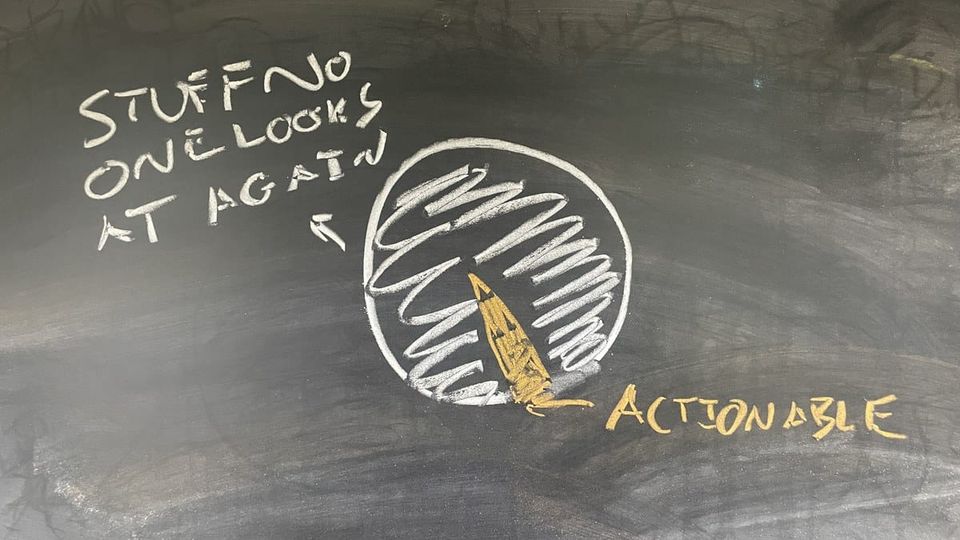
Then the plan went into a folder and the company kept doing what it was doing.
By March, half the leadership team could not have told you what was on the plan without opening the document. By June, the plan was a kind of ambient memory. By Q4, the team would gather to do the next plan, and somebody would say, "we should pull last year's plan to see what we accomplished," and the room would get a little quiet.
This is the article about why that happens. And what to do about it.
Vision is not operational until it is on the calendar
Here is the constraint, in one sentence. Vision is not operational until it is on the calender.
Most annual planning sessions produce vision. They produce themes. They produce strategic priorities. They produce a slide that says, "in 2026 we will be the leading X in Y." They produce a Year of Customer or a Year of Discipline or a Year of Whatever the leader has been thinking about lately.
What they do not produce is calendar.
The calendar is what makes the vision real. The calendar is the meeting the strategic priority will be reviewed in. The calendar is the cadence of who reports on what. The calendar is the quarterly check-in where the leader who owns the initiative actually has to look at the team and say what moved and what didn't. The calendar is the recurring fifteen minutes a week where the metric that matters gets eyeballed.
If your vision is not on someone's calendar with a recurring slot, your vision is decoration. It is not real. It will not move. The plan will be performed at the offsite and forgotten by Easter.
This is the single most predictable failure mode in leadership planning, and it does not get fixed by better planning sessions. It gets fixed by changing what the planning session is for.
Why this happens
Annual planning sessions, the way most companies run them, are designed to produce a document. They are not designed to change the operating system of the company.
The document is what the team can show the board. The document is what the leader can take home and feel good about. The document is what shows up in the all-hands the following week. Producing a document is a satisfying outcome, and it gives everyone a sense of having moved forward, which they have, on the document. They have not moved forward on the company.
To move forward on the company, the planning session has to produce changes to the operating cadence. Different meetings. Different metrics. Different recurring conversations. Different review structures. Different default questions in the existing meetings.
Almost no annual planning sessions produce that. Almost all of them produce documents.
This is the constraint I see across professional services firms, technology companies, nonprofits, and family businesses alike. The size, industry, and stage do not change the pattern. A fifty-person company does it the same way a five-thousand-person company does it. A nonprofit at twenty million in giving does it the same way a SaaS company at fifty million in revenue does it. The pattern is universal because the pattern feels productive.
The pattern is not productive. The pattern is a high-effort, low-yield ritual. It feels like work. It produces little.
What I look for when I come in
When I get pulled into an annual planning facilitation, I am looking for one specific thing.
Where on the calendar will this plan live, after the offsite ends?
I am not asking what the plan says. I am not asking who owns each initiative. I am not asking how the goals were chosen. Those questions are downstream of the real question.
The real question is, what recurring meeting will exist a month from now that did not exist a month ago, and what will happen in that meeting that touches the plan.
If the answer is "we have an exec meeting on Mondays and we will discuss it there," the plan is not going to land. The Monday exec meeting is going to be about whatever is on fire that Monday. The plan will get five minutes at the start, at best. By April, it will get zero minutes.
If the answer is "we will create a monthly strategic review where each priority owner reports on what moved this month and what is in the way," now you have a chance. The chance is contingent on whether that meeting happens, whether it's the meeting that gets cancelled when something comes up, whether the people in it actually prepare, and whether the leader running the meeting will hold the room accountable when somebody shows up unprepared.
A lot of the work I do at the back end of an annual planning session is designing those meetings. The cadence. Who owns them. What gets reported. What questions get asked. What happens when the answers are bad.
This is not the sexy part of strategic planning. It is the part that determines whether the strategic planning was real. The constraint is not lack of vision. The constraint is vision not operational.
What good looks like
A good annual planning outcome looks like this.
There is a vision document, but the vision document is the simplest artifact. It says what the company will be by the end of the year, in language a new hire could understand on day one.
There are between three and five strategic priorities. Not seven. Not twelve. Three to five. Each one has a single owner. Not a co-owner, not a steering committee. One name. The owner is the person who, on the last day of the year, has to stand up and say what happened. There is nowhere else for the accountability to go.
Each priority has a metric. The metric can be measured weekly. If the metric requires a special report or a quarterly snapshot to track, the metric is wrong. Pick a different one.
There are calendared review points. Weekly for the metrics. Monthly for progress against the priorities. Quarterly for the question, are these still the right priorities. The leader running each review has been trained to push when the answers are vague.
There is a kill criteria for each priority. The team has agreed in advance what evidence would tell them this priority is the wrong one. They have committed to checking against that evidence at the quarterly review. They have agreed they will actually kill priorities that are failing, instead of carrying them through the year out of sunk cost and politeness.
That is what a real annual plan produces. Not a deck. An operating system.
If your annual planning produces a deck, you are not doing annual planning. You are doing annual decoration.
What this looks like for nonprofits
If you run a nonprofit at five to fifty million in giving, you have all the same ingredients but you are also dealing with a board cycle, a fundraising calendar, and a program calendar that have to coexist with the strategic plan.
The same principle applies. The board does not need a more sophisticated strategic plan. The board needs to know that the strategic plan is being executed against a real operating cadence. They need to see the monthly review structure. They need to see what is on the calendar that did not exist before the planning session.
Most nonprofit strategic plans I have read are beautifully written and operationally invisible. They live on the website. They live in the case for support. They do not live in the staff calendar. The development director and the program director are running the same calendars they were running before the plan was written. The plan is performance, not operations.
The cure is the same. Take the strategic plan, and for every priority, find the recurring meeting that will hold the priority accountable. If there is no such meeting, schedule it. If you cannot find time on the calendar to schedule it, the priority is not actually a priority and you should remove it from the plan. The plan should be only as long as your calendar can support.
What to do with this
Pull up your most recent annual or strategic plan.
For each priority on the plan, answer two questions. Who is responsible, and what percentage complete is it?
If you can't answer that, then your annual planning session was a joke.
Most leaders, doing this audit honestly, will find that one or two of their priorities have a real owner and a real read on progress, and the rest are floating. The floating priorities are the ones that will not move this year.
You can fix this in an afternoon. Name the owner for each priority. Pick the metric that tells you what percentage complete it is. Schedule the recurring meeting where the owner reports against that metric. Decide what will get killed if the metric doesn't move.
That afternoon will do more for your year than two days of additional offsite. It is also free.
The annual planning session is not the work. The cadence the planning session produces is the work. If you are not building cadence, you are building decoration.
So much respect.
---
Frequently asked questions
Q: Why do most annual planning sessions fail to produce results? A: They are designed to produce a document, not to change the operating system of the company. Producing a deck is satisfying and feels like progress, but it does not change the meetings, metrics, or review cadences the team is already running. By March, the plan is a folder. By June, it's ambient memory. By Q4, nobody can remember what was on it.
Q: How do you make a strategic plan stick? A: Put every priority on the calendar with a recurring review meeting attached to it. Each priority needs a single owner, a weekly-measurable metric, and a kill criteria the team has agreed to in advance. The planning session is not the work. The recurring cadence it produces is the work.
Q: How many strategic priorities should an annual plan have? A: Between three and five. Not seven. Not twelve. Each priority needs one owner, one metric, and a dedicated recurring review. The plan should be only as long as your calendar can support. If you cannot schedule the meeting that holds the priority accountable, the priority is not actually a priority.
Q: What does it mean for a vision to be operational? A: It means the vision lives on someone's calendar with a recurring slot, not just in a document. The constraint I see most often is vision not operational. The plan exists but no recurring meeting touches it. Operational vision shows up as a monthly priority review, a weekly metric check-in, a quarterly kill-or-keep decision. Without that cadence, the vision is decoration.
Q: How should nonprofits run annual planning differently? A: The principle is identical: every priority gets a recurring review on the calendar. The added work is coordinating the strategic plan with the board cycle, fundraising calendar, and program calendar already running. The fix is not a more sophisticated plan. It is the monthly review structure the board can see, the staff calendar that has space for the work, and the willingness to cut priorities that cannot fit.