The Compassion Deficit in High-Performance Cultures
The ruthless leader is a myth with an impressive marketing budget. The image of the hard-driving executive who achieves extraordinary results through relentless pressure, high standards, and zero tolerance for anything short of excellence has been repeated often enough in business culture that it reads as received wisdom. It is not. The research on what actually produces sustained high performance in organizations tells a different story, and the story it tells is uncomfortable for anyone who has built their leadership identity around toughness as the primary variable.
A longitudinal study from UC Berkeley's Haas School of Business, published in PNAS, tracked people from before they entered the labor market and assessed the power they attained about fourteen years later. Across two studies, the people who were selfish, aggressive, and manipulative were no more likely to attain power than the people who were generous and agreeable. Their intimidation would have raised their standing, but their poorer workplace relationships canceled it out. The lead author's own summary of the bad news is that organizations hand power to disagreeable people at the same rate as everyone else. Ruthlessness does not get you ahead faster. It just does more damage once you arrive.
Toughness is not the variable. Compassion is.
This is not a case for softness. Compassion and high standards are not opposites. The confusion between them is one of the most expensive leadership errors in business, and it produces organizations that achieve in the short term and erode in the medium term in ways that are traced everywhere except to their actual source.
What compassion actually means in a leadership context
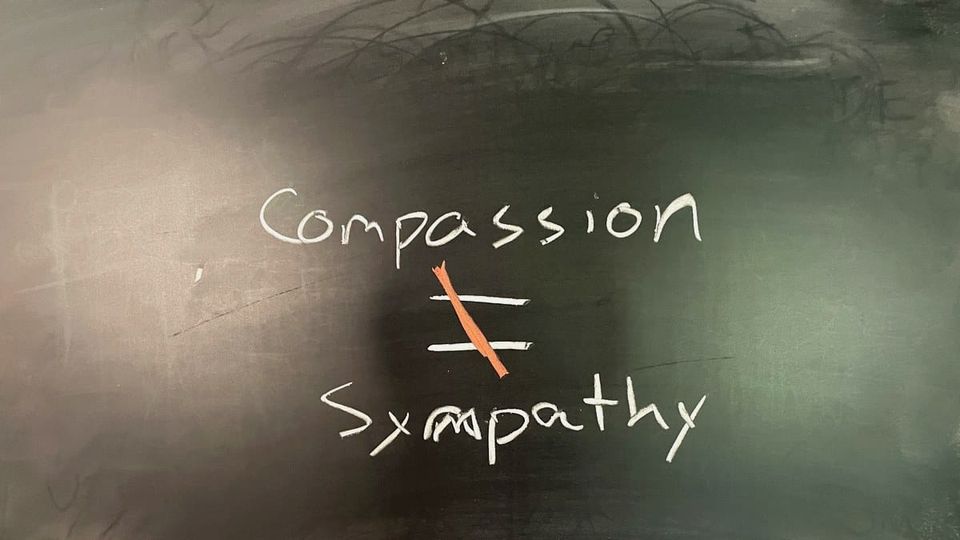
Compassion is not sympathy. Sympathy is the feeling of concern for another person's difficulty. Compassion is that feeling plus the motivation to do something about it. The distinction matters in a leadership context because compassion without action is just emotionally expensive observation. Compassion with action is what produces the leadership behaviors that the research consistently links to better performance: the honest feedback delivered with care, the difficult conversation that is hard but necessary, the investment in someone's development because you actually care whether they grow.
Compassion is also not the absence of standards. A leader who genuinely cares about the people they lead holds them to high standards not despite that care but because of it. The leader who lets a chronically underperforming team member stay in a role without honest feedback is not being compassionate. They are avoiding a difficult moment at the other person's expense. The compassionate move is the harder conversation, delivered with enough care that the person on the other side of it can actually hear it.
A Johns Hopkins study found that giving just forty seconds of genuine compassionate attention can measurably lower another person's anxiety. Not a long intervention. Forty seconds of actual presence. That is the variable: not the policy or the program or the performance management system, but the quality of attention one human pays to another in a moment when it matters.
Most high-performance cultures have optimized everything except that variable.
The performance cost of a compassion deficit
The organizations that produce the highest sustained output are not the ones with the highest pressure. They are the ones where the pressure is matched by the support, where the standards are matched by the investment in people's capacity to meet them, where the demand for performance is accompanied by genuine care about the person performing.
When the pressure is present and the compassion is absent, you get a specific organizational failure mode: high short-term output and high medium-term attrition. The top performers stay as long as their personal ambition exceeds the cost of the environment. The moment it does not, they leave. And they leave faster than the average employees because they have the most options. The organization retains the people who have the fewest alternatives and loses the ones it most needs to keep.
How burnout and depersonalization erode leadership compassion
The research on burnout and compassion is particularly relevant for leaders who believe they can manage high performance through pressure alone.
Burnout produces what the research calls depersonalization: the process by which a person who has been depleted past their capacity begins to experience the people around them as less than fully human, as problems to be processed rather than people to be engaged. Burned-out medical trainees stop being curious about patients. Burned-out customer service representatives stop hearing the person in the story. Burned-out leaders stop caring about whether the feedback lands.
Depersonalization is not a character failure. It is a physiological response to sustained depletion without recovery. The person is not choosing to care less. Their capacity to care has been consumed by a demand that exceeded it.
An organization that runs its leaders and high performers at maximum capacity without building in genuine recovery is not maximizing output. It is front-loading output and scheduling a deficit. The deficit arrives as attrition, as quality decline, as the creative and relational capacity that makes the difference between good and exceptional quietly leaving the building before anyone names what happened.
The compassion question is upstream of the burnout question. A leader who genuinely cares about the people they lead does not run them into the ground. Not primarily because it is strategically unwise, although it is. Because the care itself prevents it. The organizational structure and culture that maintains high performance over time has compassion built into its operating norms, not as a program, not as an HR initiative, but as a genuine value held by the people with the most influence over what the organization rewards and what it tolerates.
Why compassion is a learnable leadership skill, not a fixed trait
The Berkeley Greater Good Science Center research on compassion training is directly relevant here because it addresses the objection that compassion is a trait rather than a skill: either you have it or you do not.
The research is clear that compassion is more like a muscle than a temperament. It can be built through practice. Eight-week compassion cultivation training developed at Stanford integrates contemplative practice with contemporary psychology, and preliminary research suggests programs like it can increase compassion for self and others and reduce the fear of compassion. Not through personality change. Through deliberate practice.
The practices are not complicated. Active listening, the kind that is actually receiving rather than waiting to respond, increases the understanding of others' needs that compassion requires. Presence practices, the ones that reduce the ambient cognitive load that makes genuine attentiveness difficult, create the conditions where compassion can operate rather than being crowded out by the business of the day.
For leaders, the starting point is noticing when compassion is absent. The meeting where you are processing the next agenda item while someone is speaking. The feedback conversation you delivered efficiently without checking whether the other person actually received it. The performance issue you documented rather than worked through with the person. These are not necessarily failures. They are data. They tell you where your compassion capacity is being crowded out and what would need to change for it to have room to operate.
What the ruthless leader myth costs organizational culture
The persistent myth of the ruthless leader does specific damage to organizational culture beyond the direct performance costs it produces. It establishes a cultural norm that emotional toughness and interpersonal distance are signs of seriousness while warmth and care are signs of weakness. That norm cascades downward through every layer of the organization.
Middle managers in ruthless cultures do not model compassion because the culture does not reward it. They model what they see being rewarded: pressure, results-orientation, and the performance of not being affected. Their teams learn the same. The organization develops a culture where being visibly struggling, asking for support, or naming difficulty is professionally risky. Where the people who need help are least likely to ask for it because asking marks them as the kind of person who needs help.
That culture is not high-performing. It is high-producing in the short term. The difference is that high performance is sustainble. High-producing cultures that run on pressure without care have a specific degradation curve: excellent for the first few years of the company's life, increasingly fragile as the organization scales and the relational complexity increases, and eventually brittle in ways that surprise everyone because nobody named what was eroding.
The founding team that built something real in that early period did it partly on the energy of the beginning, when intrinsic motivation was high and the work felt consequential. The organization they build from that culture will not have access to the same energy source at scale. The culture they build determines whether what replaces it is compassion-based engagement or pressure-based compliance. These produce very different organizations over a ten-year arc.
How to build compassion into a high-performance culture
Start with forty seconds. Pick someone on your team who is carrying something right now. Not the person who is performing well and does not seem to need anything. The person who is carrying something. Give them forty seconds of genuine, undivided attention focused on whether they are okay.
Not as a performance of compassion. As the actual thing. Ask the question and mean it and wait for the real answer.
Then ask yourself: is the way I lead this team primarily about extracting performance from capable people, or is it primarily about creating the conditions where capable people can perform at their best? The first requires pressure. The second requires care. They are not the same thing and they do not produce the same organization over time.
The myth tells you that toughness is the primary variable. The research tells you something different. The organizations that sustain high performance over the long arc are the ones where the people inside them know that the person leading them actually gives a damn about whether they are okay.
That is not a soft standard. That might be the hardest one to meet consistently.
The compassion deficit in nonprofit organizations
Compassion in nonprofit organizations is often present toward the mission and absent toward the staff. The organization exists to serve vulnerable populations, and that service orientation is real and important. But it stops at the door. The people doing the work are expected to absorb the emotional weight of the mission without equivalent investment in their own wellbeing. The compassion flows outward toward constituents and does not circulate back to the team.
The result is sector-wide burnout patterns that have been documented extensively and addressed inadequately. The prescription is usually individual resilience training, which is the organizational equivalent of telling individuals to focus better rather than fixing the broken system. The actual intervention is organizational: building the compassion into the culture that the sector asks its people to carry outward, and directing some of it inward at the people who are doing the carrying.
Frequently asked questions
Does research actually support compassionate leadership as a driver of business performance? Yes. A PNAS study out of UC Berkeley's Haas School, tracking people across roughly fourteen years, found that selfish, aggressive, and manipulative people were no more likely to attain power than generous, agreeable ones. Their intimidation was offset by weaker workplace relationships. A separate randomized trial published in the Journal of Clinical Oncology found that about forty seconds of compassionate communication produced a measurable reduction in patient anxiety. The research picture is consistent: compassion is not a soft variable that trades off against performance. It is an upstream condition that determines whether performance is sustainable over time.
What is the difference between compassion and low standards in a leadership context? Compassion is care combined with the motivation to act on it. Low standards is the absence of expectations. The confusion between them is common and expensive. A compassionate leader holds high standards precisely because they care about the people they lead and about what those people are capable of. The difficult feedback, the honest performance conversation, the genuine investment in someone's development, these are compassionate acts. The absence of these, which is often called being nice, is not compassion. It is conflict avoidance at the other person's expense.
How does burnout reduce compassion in leadership teams and what does that cost organizationally? Sustained depletion without recovery produces depersonalization: the tendency to experience others as problems to be processed rather than people to be engaged. Burned-out leaders stop being curious about their team members, stop caring whether feedback lands, stop investing in the relational quality that makes leadership genuinely effective rather than technically functional. The organizational cost is the erosion of the trust and engagement that sustains discretionary effort, retention of top performers, and the quality of work that requires genuine presence to produce.
Can compassion be developed or is it a fixed trait? Research is clear that compassion is more skill than temperament. Stanford's eight-week compassion cultivation training programs have demonstrated measurable increases in compassion for self and others in adult participants. Gratitude practices, active listening disciplines, and presence practices all contribute to increasing compassion capacity. The muscle metaphor from Berkeley's Greater Good Science Center is accurate: compassion can be built through deliberate practice or it can atrophy through disuse.
What does the ruthless leader myth cost organizational culture beyond direct leadership effectiveness? The myth establishes a cultural norm that emotional toughness and interpersonal distance signal seriousness, while warmth and care signal weakness. That norm cascades through the organization: middle managers model what they see rewarded, their teams model what they see, and the culture develops a pattern where struggling is professionally risky and asking for support is avoided. The result is not a high-performance culture. It is a culture where the people who most need help are least likely to get it, where the relational quality that sustains sustained output erodes quietly, and where the degradation is not named until the attrition becomes impossible to ignore.
Take this if it serves you.
Much Respect,
-bryan