The Hidden Part of You That's Running Your Company
You think you run your company. You do, in the legal and operational sense. Your name is on the documents. The decisions flow through you. The culture takes its shape from how you show up every day.
But there is a more precise question worth asking. Which version of you is actually running it?
Because you are not a single, unified thing. None of us are. Different versions. Same body. Same chair. Wildly different organizational outcomes depending on which one showed up that day.
This is not a character flaw. This is how human psychology actually works. When the wrong version of you is running the company, the constraint is not the market, not the team, not the systems. The constraint is the ego as the operating system — the parts of you running on autopilot, shaping every decision and every culture signal without your awareness.
A note on where this language comes from
The framework I am working from is Internal Family Systems, developed by Richard Schwartz. IFS describes the mind as a system of parts, each with its own beliefs, fears, and protective strategies. In the canonical model, parts fall into three categories: Managers, Firefighters, and Exiles. Managers run the day-to-day defenses. Firefighters jump in when something painful breaks through. Exiles carry the original wounds the other parts are organized to protect.
What follows is my personal mapping of the specific protective parts that show up most often in the founders I work with, and the ones I spent two years of intense therapy learning to recognize in myself. These are not IFS textbook categories. They are the patterns I see in the room. If you want the formal model, the IFS literature is rich and worth reading directly.
The parts your company is actually dealing with
The model maps onto organizational behavior with a precision that should make every leader uncomfortable.
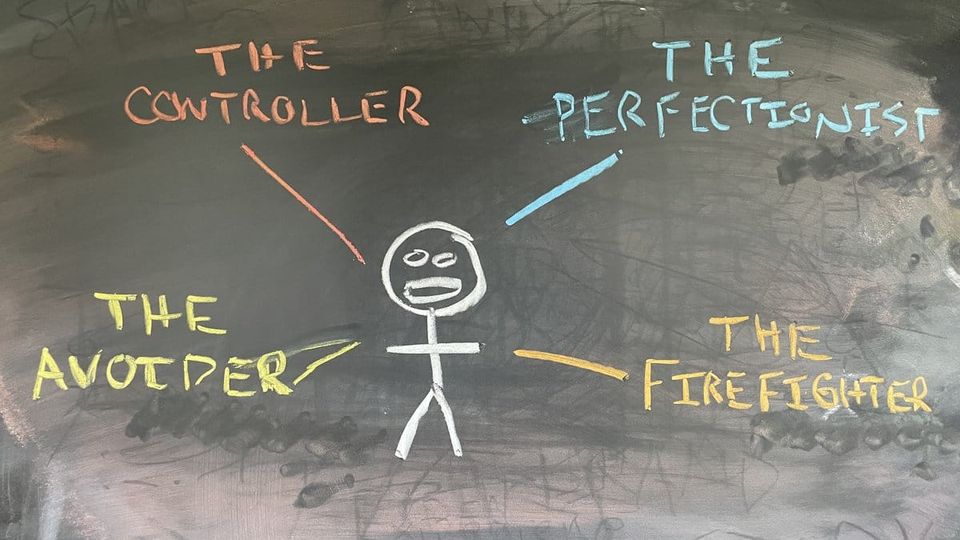
The Controller cannot let go. Every detail needs approval. Every decision gets reviewed. The Controller was useful when the business genuinely depended on one person. It is the single biggest constraint on organizational growth now.
The Perfectionist is afraid of being associated with anything that is not excellent. The Perfectionist produces a team that stops trying to meet the standard and starts trying to manage the Perfectionist's reaction to the work.
The Firefighter runs on urgency. Energized by crisis and uncomfortable in its absence. Keeps the organization in a state where there are enough fires to stay in motion.
The Avoider knows what needs to happen and cannot make itself do it. Keeps the hard conversation on the list indefinitely. Builds elaborate plans for the future as a way to avoid the present.
The problem is not the parts. The problem is when the parts are running the company without the founder knowing it.
What leading from True Self looks like
The IFS framework describes a core self — True Self — that is distinct from the parts. The True Self is the observing presence that can see the parts clearly and make choices that are not driven by any single part's fear or protective strategy.
The leaders who have done real personal work often describe the shift the same way. The decisions feel cleaner. The relationships feel more honest. Not because the leader became nicer, but because the team is no longer having to manage the parts.
How the parts shape organizational culture
Your parts do not stay contained to your behavior. They propagate.
The Controller produces an organization where the director team develops a learned helplesness about deciding things independently.
The Perfectionist produces an organization where people are afraid to show unfinished work. Velocity slows and the best ideas die before they are good enough to show to the leader.
The Firefighter produces an organization that runs in a state of manufactured urgency. Strategic thinking is perpetually crowded out by the fire of the week.
The Avoider produces an organization where the real conversations never happen in the room. The culture feels cordial and slightly dishonest.
The culture is a downstream effect of which part showed up to run the company today. The same protective patterns that helped you survive an earlier phase of the business often become the ceiling on the next one.
How to start seeing your parts
The most reliable way to identify which part is running in a given moment is to notice the quality of your thinking and the speed of your reaction. True Self responds. The parts react. A reaction is driven by something older than the current situation.
It is a practice, not a technique. The leaders who develop real fluency with it have usually been working with a coach or therapist who can help them build the recognition pattern over time. Mine did. Three years of consistent work to learn to recognize, in real time, which part had walked into the room with me.
What this looks like for nonprofits
The mission makes it harder to see the parts because the energy the parts generate often gets channeled into the mission in ways that look like dedication. The Controller looks like high standards. The Firefighter looks like passion. They are also the ego as the operating system — constraints on the organization's capacity to grow beyond the parts system of the person running it.
What to do with this
This week, pick one recurring meeting that you run. Before the next instance, spend ten minutes writing down which part of you tends to show up in it. Not which part you want to show up. Which part usually does.
Then ask yourself what the meeting would look like if True Self ran it instead. The gap between those two versions of the meeting is the work. You do not have to close it all at once. You just have to start seeing it.
Frequently Asked Questions
Q: What is Internal Family Systems and how does it apply to leadership? A: Internal Family Systems, developed by Richard Schwartz, is a psychological framework that describes the mind as containing distinct parts, each with its own beliefs, fears, and protective strategies. The canonical model has three categories: Managers, Firefighters, and Exiles. Applied to leadership, IFS gives you language for the fact that you are not a single, unified version of yourself walking into the boardroom. Different parts of you run the company at different times. The leadership work is learning to recognize which part has shown up and choosing to lead from True Self instead.
Q: How does ego shape company culture without the founder realizing it? A: The constraint is the ego as the operating system. The parts of you that run on autopilot do not stay contained to your behavior. They propagate into the team. The Controller produces a team that cannot decide anything independently. The Perfectionist produces a team that is afraid to show unfinished work. The Firefighter produces a culture of manufactured urgency. The Avoider produces an organization where the real conversations never happen in the room. The culture is a downstream effect of which part of you showed up to run the company today.
Q: What is True Self in IFS, and what does leading from True Self actually look like? A: True Self in the IFS framework is the core observing presence that is distinct from the parts. The True Self can see the parts clearly and make choices that are not driven by any single part's fear or protective strategy. Leaders who have done real personal work describe the shift the same way: the decisions feel cleaner, the relationships feel more honest. Not because the leader became nicer, but because the team is no longer having to manage the parts.
Q: How do I know which part of me is running the company in any given moment? A: Notice the quality of your thinking and the speed of your reaction. True Self responds. The parts react. A reaction is driven by something older than the current situation. The practice is recognizing, in real time, which part has walked into the room with you. Most leaders develop this fluency working with a coach or therapist over time. It is a practice, not a technique. The reps build the recognition pattern.
Q: Why does ego as the operating system matter more for nonprofit executive directors? A: The mission makes it harder to see the parts because the energy the parts generate gets channeled into the mission in ways that look like dedication. The Controller looks like high standards. The Firefighter looks like passion. The Avoider looks like patience. The mission absorbs the protective strategies and disguises them as virtue. The team experiences the parts directly, even when the board and the donors only see the dedication.
So much respect.