You Have 144 Brand Ambassadors and You're Not Using Any of Them
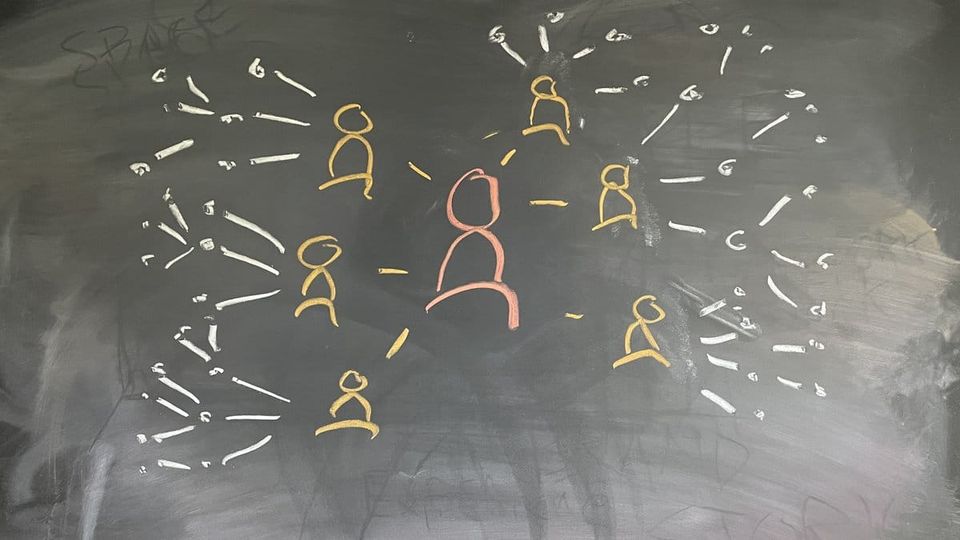
You have a team. Your team has families and friends and former colleagues and LinkedIn connections and people they grew up with. Your customers have networks too. Your former employees, your vendors, your partners. Add it all up, take a conservative average, and you are looking at a few hundred to a few thousand people in your extended brand orbit.
Almost none of them can articulate what your company actually does, who it specifically serves, or why anybody should choose you over the alternatives.
This is not because they do not care. They care. They would say nice things about you if you asked them. The reason they cannot articulate the story is that nobody in your company can articulate it cleanly either, and certainly nobody has equipped your team to tell it.
Your story is not internalized by the people who would carry it furthest if you let them.
This article is about that constraint — the story not internalized by the team. It is one of the most common, most invisible, and most under-leveraged opportunities in companies at the ten-to-fifty-million revenue range. Fixing it does not require a new brand. It requires a different kind of internal work most founders skip.
Why the story doesn't live in your team
Walk into your office tomorrow and ask any five employees the same question. What does the company actually do, who is it specifically for, and what would somebody pay us for that they cannot get from anybody else.
You will get five different answers. The marketing-adjacent person will give you a version closest to the website. The sales person will give you a version oriented around their pitch. The operations person will give you a description of the work itself. The newer employee will give you a vague answer because they are not sure yet. The veteran will give you a version from three years ago that is no longer current.
None of them will give you the same answer. None of them will give you the answer you would give if somebody asked you on a stage in front of investors.
This is not a personnel problem. It is the predictable result of how brand and story work gets done in most companies. The team picks up fragments by osmosis. Different people pick up different fragments. The result is a workforce that is loyal, hardworking, capable, and unable to articulate what they collectively do for a living in a way that would help the business grow.
The cost is larger than you think
Every employee who cannot articulate the story is a missed referral channel. A clear version, internalized properly, would produce one to three meaningful inquiries per employee per year. A team of forty employees is potentially leaving forty to a hundred and twenty inbound conversations on the table annually.
Every employee who cannot articulate the story is a misaligned hire over time. The team's hiring choices, over five years, drift toward whatever version of the company the team thinks they are part of.
Every employee who cannot articulate the story is a customer touchpoint that does not reinforce positioning. Add those three costs together and the gap is not minor. It is one of the largest sources of underperformance in companies that have otherwise done their brand work well at the marketing layer.
Why founders skip this work
Founders assume internalization happens automatically. It does not. Internalization requires deliberate practice, and deliberate practice requires structured work, and the structured work has not been scheduled.
Founders treat brand as marketing's job. Your team is the brand's primary distribution channel after the website. Treating them as audience instead of distribution leaves enormous leverage on the table.
Founders are afraid of forcing a script. Internalization is not training. It is the team genuinely understanding the story well enough to tell it in their own words, in any context, without a script in front of them.
And sometimes founders have not actually nailed the story themselves. The story never gets sharp without the team work, because those conversations are part of how the story sharpens.
What real internalization looks like
The work has four parts.
A clear, written, finalized version of the story. Not the website. The internal version. Two to three pages. Includes who the company is for, who it is specifically not for, what specifically it does that the alternatives do not, and why this matters in the customer's life.
A founder-led conversation about the story. Not a slide presentation. A conversation. The founder explains the choices behind the story. People remember reasoning. They forget conclusions.
Practice. The team actually tries to tell the story. Out loud. To each other. Awkwardly at first. Better over time.
Recognition. When an employee sends in a great inbound lead because they had a sharp two-minute conversation at a dinner, that gets celebrated publicly. The behavior is reinforced. People do more of what gets seen.
Four parts. Document, conversation, practice, recognition. Most companies do one. The companies that do all four have teams that genuinely understand and can carry the story.
What this looks like for nonprofits
If you run a nonprofit, you have an even bigger version of this opportunity. Your extended group — staff, board, volunteers, donors, alumni — is often in the hundreds or low thousands. Almost none of them can articulate your specific theory of change in a way that produces additional support.
A board that can articulate the mission produces seven-figure introductions. A board that cannot is decorative.
What to do with this
This week, run the test. Privately, individually, ask five employees the question. What does the company do, who is it specifically for, and what would somebody pay us for that they cannot get elsewhere. Listen carefully. Do not correct. Just collect.
If you get five different answers, you have just confirmed the gap. The next step is the four-part work. Document. Conversation. Practice. Recognition.
The work takes a few months to install and pays off for years. The team you have today is more than enough infrastracture to grow your business meaningfully if you equip them. Most founders never do. The ones who do operate at a different level of leverage than their peers.
You have 144 brand ambassadors, give or take. They are willing. They are loyal. They are not equipped. Equip them.
So much respect.