I Stay Busy So I Don't Have to Face the Hard Thing
I'm in the pool at 5:15 AM most days. Then on the bike. Then on a run. Then back in the pool the next morning. Twelve to fifteen hours of training a week most weeks, more when I'm peaking. Long miles. Sore everywhere. Asleep by nine. Up before the sun.
People see the schedule and assume it's discipline.
It is. But that's not the whole story.
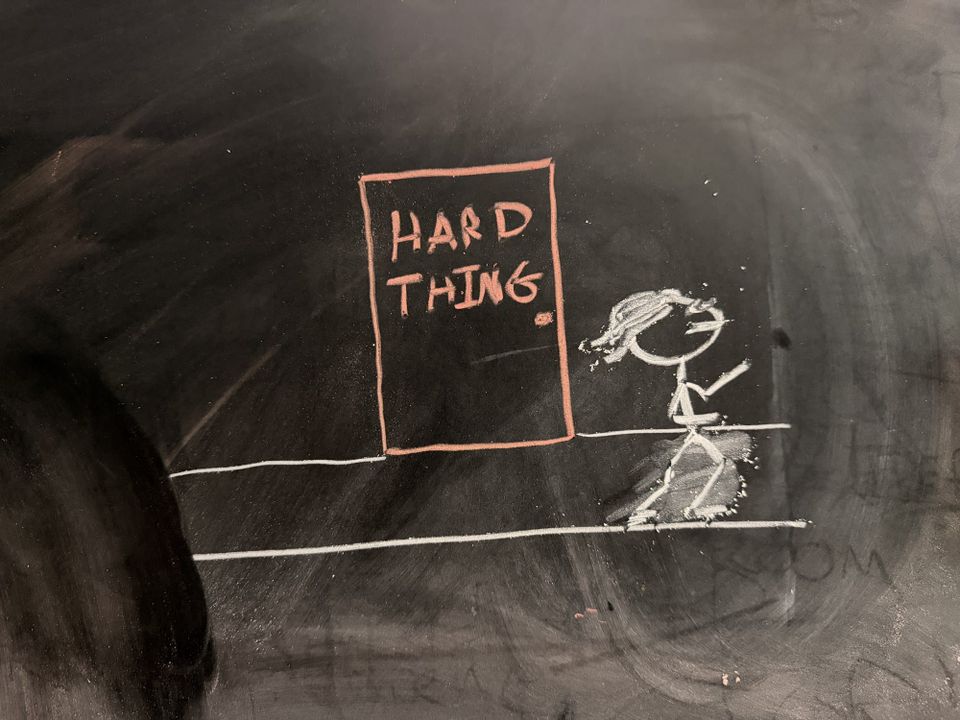
The other half of the story is that I figured out, somewhere along the way, that some of those hours were not training. Some of those hours were a really productive way of not doing something else.
That's the article.
Why does working hard feel like progress when nothing moves?
The single most common pattern I see in founders, CEOs, executive directors, and leadership teams is this. They are working hard. They are working long hours. They are putting in real, visible, measurable effort. Anyone watching them would say, "this person is grinding."
And yet the thing that needs to move is not moving.
The strategic priority that's been on the slide for two years has not moved. The hire that needs to happen has not happened. The conversation with the partner has not been had. The board update that needs to be honest is still being polished into something it isn't.
But the leader can list every other thing they did this week. Twelve hours of meetings. Eight pages of strategy doc. Three coffees with potential partners. Two pitches. A board prep session. A rolling crisis with a vendor.
This is the constraint I call Avoidance Masquerading as Effort.
You are not slacking. You are not lazy. The opposite. You are working harder than anyone you know. The work is real work. The effort is real effort.
But none of it is touching the thing that actually has to move. And the volume of the other work is keeping you from having to look at why.
How does hard work become a way to avoid the real problem?
Triathlon training is a near-perfect environment for productive avoidance.
The hours are unimpeachable. Nobody questions a 5 AM swim. Nobody questions a four-hour bike ride on a Saturday. Nobody questions a long run on a Sunday. The schedule is its own justification. The schedule is also socially honored. People look at you with a kind of awed concern. You feel virtuous.
Inside that envelope, you can avoid almost anything.
You can avoid the marriage conversation because you have to be in bed at nine. You can avoid the hard performance review because you have a brick workout in the morning. You can avoid the strategy decision because, frankly, you are too tired tonight and you'll think clearly about it after the next training block. The training block ends. There's another one. There's always another one.
I caught myself doing this and it embarrassed me.
I caught myself using a workout to skip a phone call. I caught myself scheduling intervals during the window when I knew a difficult email needed a response. I caught myself convincing myself that the run was non-negotiable when in fact what was non-negotiable was the ten-minute conversation I was using the run to dodge.
Endurance training did not cause my avoidance. My avoidance hijaked my endurance training.
That distinction matters.
What endurance training taught me about facing hard things
Once I caught the pattern, the same training started to teach me something useful.
The thing about endurance work is it strips everything away. Five hours into a long ride your professional self is gone. Your social self is gone. Your strategic self is gone. What's left is the thing that has been chewing on you in the back of your mind for the last six weeks.
If you are willing to stay with that, the ride becomes diagnostic. The ride tells you what you have been avoiding. The ride tells you who you are scared to talk to. The ride tells you what decision you have actually already made and have been pretending you haven't.
Most endurance athletes I know use the work to escape this exact diagnosis. They listen to a podcast. They listen to music. They run with a friend who fills the silence. They find any way they can to keep the ride from becoming the conversation.
I did that for years.
When I stopped, the training got harder and more useful at the same time. It cost more. It also gave more.
What's the sign that a busy leader is actually avoiding something?
When I work with a CEO or an ED who has spent the last six months looking like they are crushing it, I have learned to watch for one specific tell.
Volume.
Not output. Volume.
A massive volume of meetings, coffees, slides, emails, travel, projects, side initiatives. A schedule so full it functions as armor. A leader who can not be reached because they are in a thing because they are about to be in another thing because they are flying to the next thing.
If you ask them what is moving, they can tell you everything that is happening. They will struggle to tell you what is moving.
That gap. The gap between everything happening and anything moving. That gap is where Avoidance Masquerading as Effort lives.
I know it because I have lived in that gap. The training was just my version of it.
How do I tell if I'm busy or actually making progress?
This week, do this exercise.
List the five biggest things in your business or your mission that have to happen for the next twelve months to be the year you want it to be.
Now look at your calendar for the last fourteen days.
How many hours did you spend on those five things? Not adjacent to them. On them. Direct, focused, undefended hours.
Most leaders, when they do this honestly, find the answer is somewhere between four and eight hours over two weeks. Out of two hundred plus working hours. Most of which were spent on things that were urgent, real, and unrelated to the five things they just said are most important.
That is what the gap looks like on paper.
The gap is not because you are bad at your job. The gap is because the work that moves the five things forward is harder, lonelier, and more uncertain than the work that fills the calendar. So the calendar wins.
Until you decide it doesn't.
Frequently asked questions
Why do I stay busy but never make real progress? Sustained effort can function as avoidance rather than production, and the two are nearly indistinguishable from the outside because the work is genuinely real. A leader can fill every hour with legitimate activity while the one thing that actually needs to move stays untouched, because the volume of that activity provides cover for not facing it. The busyness is not laziness and it is not fake, which is exactly what makes it effective as avoidance: it lets a person work hard and avoid the hard thing at the same time.
What is avoidance masquerading as effort? It is the pattern of routing enormous energy into real but secondary work as a way of not doing the highest-stakes thing on the list. The hard conversation, the strategic decision with no clean answer, the admission that something is not working, all sit untouched while the calendar fills with meetings, travel, and deliverables that are useful and urgent and beside the point. The effort is what disguises the avoidance, which is why the people running this pattern are often the hardest workers anyone knows.
How do I tell productive work from avoidance? The diagnostic is direct: list the five things that most have to happen for the year to go the way you want, then count the hours over the last two weeks you spent directly on them, not adjacent to them. Most leaders who do this honestly find the number is startlingly low against a calendar that was completely full. That gap, between everything that happened and the little that moved, is where avoidance lives, and it is visible on paper the moment you are willing to look.
Why do high performers avoid the most important work? The highest-leverage work is almost always the hardest, loneliest, and most uncertain, while the work that fills the calendar is urgent, social, and immediately rewarding. Given the choice on any given day, the brain routes toward the work that offers quick resolution and away from the work that offers ambiguity and risk. This is not a character flaw specific to weak performers; it is a default the most driven people are especially good at hiding, because their genuine productivity makes the avoidance invisible to everyone including themselves.
How do I stop avoiding the hard thing? Naming what the busyness is protecting you from is the first move, because the avoidance depends on staying unexamined. Once you can see that the training block, the packed calendar, or the endless email is standing in for a specific conversation or decision, the pattern loses its cover. Then schedule the actual thing, the real conversation or decision, into the next five days, before the volume of other work reorganizes to hide it again. The doing is what breaks it; awareness alone tends to become one more thing you are busy with.
Take this if it serves you. Much Respect, -bryan