The Environment Is the Intervention
You hire a facilitator. You fly your leadership team in. You book a hotel conference room with the standard square tables, the carafe of weak coffee, the projector, the fluorescent overhead lights, the faintly chemical smell of yesterday's catering.
Then you wonder why the conversation stays surface.
You spend more than you think on a two-day off-site. The combined cost-per-hour of your highest-paid people in a room together compounds into the tens of thousands before lunch on day one. Add the travel, the prep time, the meals, the loss of whatever those people would have been doing back at the office, and the real number gets uncomfortable. The room you put all of that in costs four hundred bucks. Nobody talks about this. The agenda is twenty pages. The pre-read is forty. The KPIs are dialed. The room is whatever the hotel had open.
I'm telling you the room is the work.
THE ENVIRONMENT IS THE INTERVENTION
Most consulting and coaching treats the room as neutral. As if the four walls, the lighting, the smell, the music, the chairs, the table shape, the temperature, what's hanging on the walls, what's NOT hanging on the walls, none of it shows up in what your team is willing to say.
That is wrong. Profoundly wrong. And it is the most under-priced lever in leadership development.
If your director can't have a hard conversation in your office because the office is a status object designed to remind everyone whose office it is, the office is not neutral. It is an active participant in the silence.
If your team gathers in a windowless conference room with a clock visible from every chair, the clock is in the conversation. It's interrupting every paragraph. It's pulling people back to their inboxes before they've finished a thought.
If your off-site is in a hotel ballroom that hosts insurance conferences on alternating weekends, your team is unconsciously matching the energy of insurance conferences. They will speak in the cadence the room has been trained to receive.
The environment is not the backdrop. The environment is the intervention.
WHY MOST LEADERSHIP WORK IGNORES THE ROOM
Because the work people get paid to do is the work that looks like work.
Frameworks. Slide decks. Action items. Four quadrants on a flip chart. A moderator with a marker. An agenda printed on cardstock.
None of that is wrong. I do all of it. I run Theory of Constraints. I run SWOT. I run Magic Wands. I print the agenda. I bring the markers.
But before any of that does any work, the room has to do its work.
The room has to lower people's nervous systems enough that they can actually hear each other. The room has to take their phones out of their hands long enough that they remember they're sitting next to a human. The room has to interrupt the script their professional self defaults to so a different self has a chance to speak.
If the room doesn't do that, my frameworks don't matter. They become more vocabulary. More buckets. Another printout to put in another binder.
This is what most facilitators miss. The framework is downstream of the room.
WHAT I PAY ATTENTION TO
Music. Not background music. Specific music. Different for the morning. Different for the lunch transition. Different for a hard conversation. Music isn't ambient. It's a variable. I select it.
Smell. The hotel chemical smell is an active sabotage of trust. I bring my own. Cedar. Sometimes citrus. Sometimes nothing on purpose, because the absence is the signal. The nose tells the body whether it's safe.
Light. Overhead fluorescents are an interrogation. I turn them off. Lamps. Windows. Daylight if I can get it. Warm light, never cool. People do not tell the truth under cool light. They tell their resume under cool light.
Room shape. Square tables turn meetings into negotiations. Round tables turn them into conversations. No table at all turns them into something else again. I pick the table to match the work.
Walls. What's on them. What's NOT on them. Sometimes the work is to put the constraints on the walls. Sometimes the work is to take everything off and let the walls be empty for a while. Empty walls are a permission slip.
Temperature. A degree too cold and people are guarded. A degree too warm and people drift. Dialed in, you can hold a hard conversation for three hours and nobody notices the time.
Phones. The phone is in the room whether you want it there or not. I make a deal up front. The phones go in a box. The box goes in another room. The deal is named. The deal is honored. Anyone who breaks it is interrupting twelve other people, not one.
What you put in your stomach. Heavy lunch and the afternoon is a wash. I plan the lunch. I coordinate with whoever is feeding us. The lunch is part of the agenda. The lunch is part of the system.
Time signature. Some sessions are fifty minutes. Some are ninety. Some are twenty. The length of a session is a design choice, not a default. The wrong length and the conversation either doesn't open or collapses past the point of usefullness.
WHERE THIS COMES FROM
I figured this out as a teenager building a recording studio in a basement.
I've told that story elsewhere. The short version. I learned that the difference between a band that produced a great record and a band that produced a flat one was not the band. It was the room. Same musicians, same equipment, different walls, different acoustics, different lighting, different mood. Different records.
That principle has held for me through every season of work since. Brand strategy work. Agency work. Leadership facilitation. CEO coaching. The variable that changes how good the output is, more than the framework, more than the skill of the facilitator, more than the talent in the room, is the room.
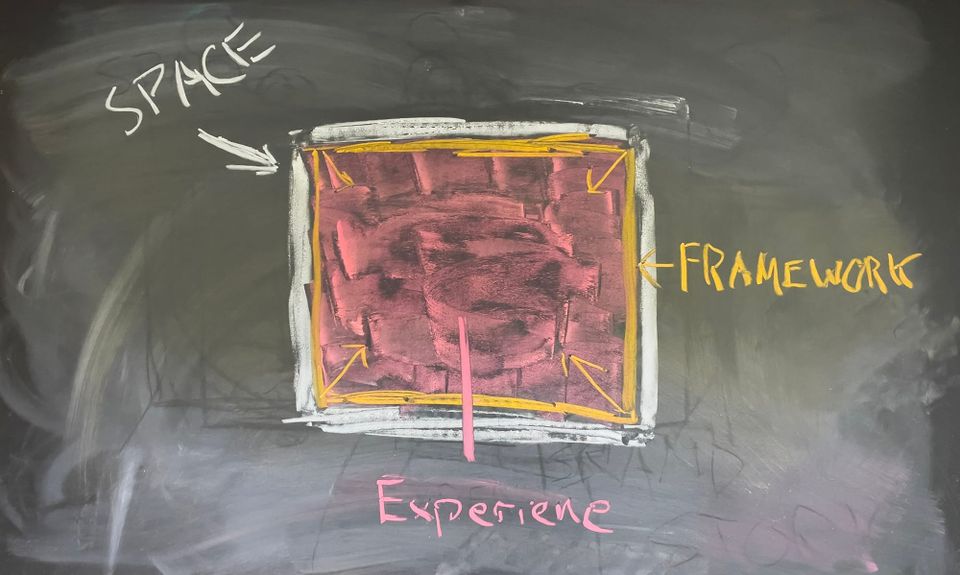
The room is the intervention. The framework is what gets done inside the intervention.
WHAT TO DO WITH THIS
Audit the room you do your most important work in.
Not the conference room you book once a quarter. The room where the actual decisions get made. Your office. Your team's standing meeting. The board prep room. The donor conversation room.
Sit in it. Alone. For ten minutes. No agenda. Just sit in it. Notice everything. The light. The smell. The chairs. The walls. What you can hear. What you can't.
Ask yourself, honestly. Is this room helping the conversation I need to have, or fighting it.
Most rooms are fighting it.
You don't have to redesign your headquarters. You have to redesign the rooms where the work actually happens. Sometimes that means a different table. Sometimes a different floor. Sometimes a different building. Sometimes a different hour of the day.
The cheapest, highest-leverage move in leadership development is changing the room.
That's where I'd start.
So much respect.
Frequently Asked Questions
Q: What does "the environment is the intervention" mean in leadership development? A: It means the room where leadership work happens is not a neutral container. It is an active participant that shapes what people say, how clearly they think, and whether the framework can do its work. The walls, the light, the smell, the table shape, the temperature, the music, and the food are all variables that determine outcomes. The framework is downstream of the room.
Q: What variables actually matter when designing a leadership workshop space? A: Music chosen for each phase of the day, not background ambient. Smell that is not the hotel chemical baseline. Warm light from lamps and windows, never overhead fluorescents. Round tables for conversations, square tables for negotiations. Phones in a box in another room. Lunch planned to support the afternoon, not sabotage it. Each variable is a design choice, not a default.
Q: Why do most facilitators ignore the room and only focus on the framework? A: Because the framework is what people get paid to deliver and what looks like work. Slide decks, four quadrants, action items, agendas printed on cardstock. The room work is invisible until it is missing. When the room fights the conversation, the framework becomes more vocabulary in another binder. The framework is real work, but the room has to do its work first.
Q: How much should I invest in the room for a leadership off-site? A: The cost-per-hour of your highest-paid people in a room together compounds into the tens of thousands before lunch on day one. The room you put them in usually costs four hundred bucks. The under-investment in the room is the most under-priced lever in leadership development. You do not have to remodel your headquarters. You have to be intentional about the rooms where the actual decisions get made.
Q: How do I audit the room I do my most important work in? A: Sit in it alone for ten minutes with no agenda. Notice everything. The light. The smell. The chairs. The walls. What you can hear. What you cannot. Then ask yourself, honestly, is this room helping the conversation I need to have or is it fighting it. Most rooms are fighting it. The fix is rarely a remodel. It is usually a different table, a different floor, a different building, or a different hour of the day.