The 350-Mile Bike Race
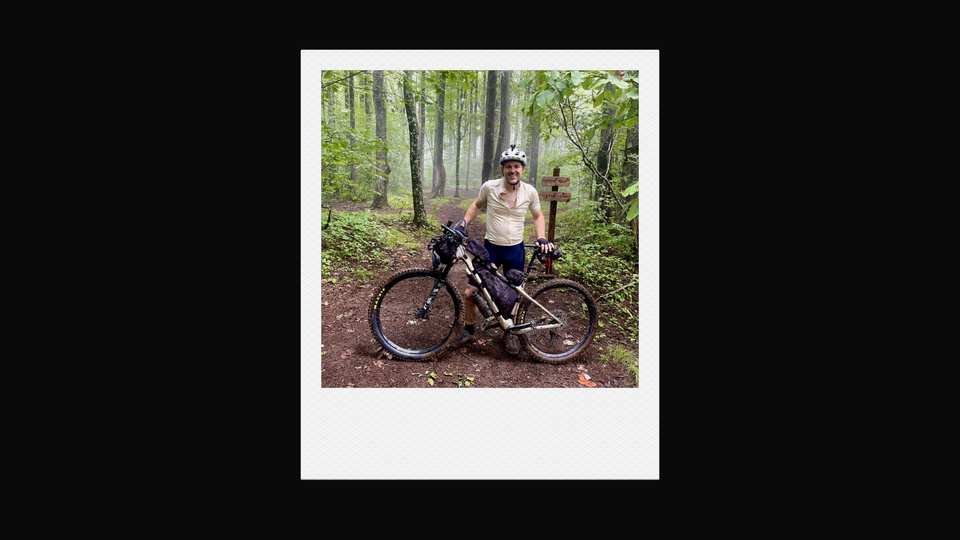
A few years ago I rode the Trans North Georgia Adventure (TNGA) with my brother Jonathan and my buddy Bryan Emory. TNGA is a 350-mile bikepacking route through the southern Appalachians. South Carolina to Alabama. About 57,000 feet of climbing. Roughly seventy percent unpaved, mostly singletrack and forest roads through the Chattahoochee and Cohutta Wilderness. Self-supported, which means you carry your own gear, sleep where you sleep, fix your own bike when something breaks. People do it in two and a half days if they are racing it. We were not racing it.
People who write about endurance events usually write about what they suffered. The ones who write about bikepacking races write about the rain, the cold, the hike-a-bikes, the moment they nearly quit at mile two hundred and seventy when their knee was screaming and the next supply point was thirty miles away.
I'm going to tell you something different.
TNGA was perfect.
Not perfect in the toxic-positivity sense. Perfect in the sense that for the first time in years, I had three full days where my mind got quiet for hours at a stretch and I could feel myself thinking again, instead of just reacting.
I want to tell you what that was like, because I think it is the actual thing every CEO I meet is trying to access and almost none of them have a doorway to it. The article is about the doorway.
The chatter
If you are running a company, your mind is loud. All the time. You know what I am talking about.
The chatter is the strategic worry, the business worry, the cash worry, the family worry, the email you didn't respond to, the conversation you should have had with the director three weeks ago, the deal that might not close, the deal that did close and is now your problem, the kid's thing, the spouse's thing, the thing you said in the meeting that you're worried came across wrong. The chatter doesn't stop when you sit down. The chatter doesn't stop when you go for a walk. The chatter doesn't stop when you try to meditate. For most leaders, the chatter is a constant background frequency that they can't actually turn off.
The chatter is not thinking. That is the part most leaders miss. The chatter is the noise that prevents thinking. You can have a brain full of chatter all day and never have a single clear thought.
You can sit at your desk for ten hours, reviewing decks, jumping on calls, answering Slack, and not actually think one new thing about your business. The chatter is using all the available bandwidth. You are doing inputs and outputs, but no actual processing.
This is the thing nobody tells leaders. The chatter is the constraint. Not the schedule. Not the team. Not the cash. The chatter, because it is what keeps you from accessing the parts of your brain that would actually solve the constraints if you could get to them.
What happens on a long ride
When you start a long ride, the chatter is the first thing that shows up. You are pedaling and your mind is racing. The same loops you had in your head in the parking lot are still in your head an hour in. The work problem. The conversation. The thing you did not finish. Your brain goes through its inventory of unresolved items because it always goes through its inventory of unresolved items the moment you stop forcing it to focus on something else.
Then somewhere around the two- or three-hour mark, something happens.
You realize, suddenly, that you do not know what you have been thinking about for the last forty-five minutes. Maybe an hour. The chatter is gone. You did not consciously stop it. You did not meditate it away. You did not journal it out. It just stopped, because the bike and the trail and the climbing and the breath required enough of you that the chatter ran out of bandwidth and tapped out.
That is the doorway.
In the runner's high state, which I hit twice a day for three days straight on TNGA, you are not thinking about your problems. You are not thinking at all. You are pedaling. You are looking at the trail. You are noticing the light through the trees. You are aware that your body is doing the work and your mind is along for the ride.
And here is the thing nobody tells you about that state. Real thinking happens after you leave it.
When you get to camp at the end of a day like that, when you are eating something and laying in your bivvy and looking at the stars, the thoughts that show up are not chatter thoughts. They are the actual thoughts. The strategic ones. The clear ones. The ones that have been waiting for the chatter to die down so they could be heard.
I made more clear-headed decisions about my work in three days on that bike than I had in the previous twelve months at my desk.
The bear and the meth heads
I should be honest. There was tension on the ride. Two moments.
I was racing down a mountain at maybe thirty miles an hour and a black bear stepped out into the trail in front of me. I did not hit the bear. The bear did not hit me. We avoided each other by maybe twenty feet, both of us pretty surprised. I had about a quarter of a second to make a decision and my body made it before my brain did.
The other tension was meth heads in the woods. Northern Georgia, deep National Forest, you ride past camps that you should not ride past. People living off the grid for reasons you do not want to know. You go through fast and you do not stop. Self-supported also means self-protected, and there is nobody coming if something goes wrong out there.
These are not metaphors for leadership. They are real things that happened, and I am telling you about them because I want to show you something about presence.
In the bear moment and the meth-head stretch, my mind was not chattering. There was zero room for chatter in my head. There was bear and not bear, then there was no bear. There was the camp coming up and the camp not coming up, then it was past me. Real presence is not a thing you achieve through breathing exercises. Real presence is what happens when something demands enough of your attention that the chatter goes silent because the chatter is not equipped to handle whatever is in front of you.
The bike does that across hours. The bear does it in a second. Different volumes of the same effect. The chatter goes off and the actual brain comes back online.
This is the other side of avoidance
I wrote another piece about training for an Ironman. The lesson there was that effort can be avoidance dressed up as discipline. You can train twelve hours a week to escape a conversation you should be having with your team. The training looks like commitment. It is actually a sophisticated form of running away. That is the constraint I call avoidance masquerading as effort.
Long endurance work can be both things. That is what I want to land in this article. The same activity can be avoidance OR it can be presence, and the marker that tells you which one you are doing is the chatter.
If you are out on a long ride and the chatter never stops, you are using the ride to avoid. The work is bypassing the chatter geographically but not energetically. Your body is on the bike and your mind is back at your desk. That is avoidance masquerading as effort.
If you are out on a long ride and the chatter quiets down somewhere in hour three, you are using the ride to access presence. Different mode entirely. The work is producing the conditions for clarity, not the conditions for escape.
Most leaders never feel the difference because they never put themselves in a situation that lasts long enough or demands enough to actually run the chatter out of fuel. A two-hour gym workout will not do it. A walk around the block will not do it. A weekend trip with a busy itinery will not do it. You need somewhere between four and ten hours of sustained effort, repeated over multiple days, in an environment that does not let your phone become the chatter substitute, before the bandwidth gets low enough that the chatter actually stops.
This is hard for CEOs to schedule. Most CEOs cannot get four hours of clear time in a row, much less three days. So most CEOs never reach the doorway. They live their entire careers inside the chatter.
What to do with this if you are not a cyclist
I get it. You are not going to ride TNGA. Your version of this is going to look like something else.
The principle is what matters. You need a recurring physical activity that lasts long enough and demands enough of your attention that the chatter is forced to stand down. Different things work for different people. Long hiking. Open-water swimming. Trail running. Surfing. Boxing. Building a stone wall. Splitting wood. Long rowing. Long backcountry skiing. Whatever it is, two things have to be true.
It has to last long enough. Sub-two-hour activities almost never get you past the chatter. You need a multi-hour minimum. The longer the better.
It has to demand attention from your body. If your body can do it on autopilot, your mind will fill the space with chatter. The activity has to occupy you physically in a way that does not leave a free channel for the chatter to run on.
If you are an executive director or a CEO of a company doing five to fifty million in revenue or in giving, this matters more for you than for almost anyone else, because the cost of operating from chatter is highest at your level. You are the person making the decisions that cost the most when they are wrong. You should not be making them while you are running on noise.
Find your doorway. Build it into your year. Not as a vacation. As an operating-system requirement, the same way you would budget for a board offsite or an annual planning retreat.
Three days a year on the bike, or in the woods, or on the water, has produced more strategic clarity for me than any planning meeting I have ever sat in. That is not a flex. That is a confession. The work I do at the desk is downstream of the work the chatter is allowed to do or not do. When the chatter is loud, the desk work is reactive. When the chatter has been forced to stand down for a few days, the desk work is real.
This is the actual self-care that leaders need. Not the spa. Not the meditation app. The thing that runs the chatter out of fuel for long enough that you can hear yourself again.
So much respect.
---
Frequently asked questions
Q: How do you think clearly as a CEO? A: You have to get past the mental chatter that uses up all your decision-making bandwidth. Chatter is not thinking. It's the noise that prevents thinking. The only reliable way to get past it is a sustained physical activity that lasts long enough and demands enough of your attention that the chatter runs out of fuel. Usually four to ten hours, repeated over multiple days.
Q: What is avoidance masquerading as effort? A: It's when a leader uses a high-effort activity, training for an endurance event, working twelve-hour days, packing the calendar, to escape something they should be addressing directly. The activity looks like discipline. It is actually a sophisticated form of running away. The marker that distinguishes avoidance from presence is whether the mental chatter quiets during the work. If it never stops, you are avoiding.
Q: Why do most CEOs feel mentally exhausted but unable to think clearly? A: They are operating from chatter, not from thinking. Their available cognitive bandwidth is consumed by unresolved loops, strategic worry, and reactive noise. They can sit at a desk for ten hours, do inputs and outputs all day, and not produce a single new strategic thought. The fix is not more hours. The fix is conditions that force the chatter to stand down.
Q: How long does it take to get into a flow state on a long ride? A: Two to three hours for most people. The first hour or two, the chatter is loud. Around hour three, the brain runs out of bandwidth to maintain it and the chatter goes quiet on its own. That is the doorway. The strategic thinking happens after you leave the flow state, usually at camp at the end of the day, when the actual thoughts come up.
Q: What kinds of physical activities help executives think more strategically? A: Anything that lasts long enough and demands enough physical attention that the chatter cannot run alongside it. Long hiking, open-water swimming, trail running, surfing, boxing, splitting wood, long rowing, backcountry skiing. Two conditions: multi-hour minimum, and the body cannot be on autopilot. If your body can do it without thinking, your mind will fill the space with chatter.