Every Space Has a Story
An A/E firm based out of Atlanta, GA. I worked with them for about three years. The leadership of that firm became mentors to me, and the relationship is still alive a decade later. The work we did set them up for the next ten years of growth, and they have grown year over year ever since. At the time we worked together they had completed over a thousand projects across thirty-eight states, federal and local government work, education, mission critical, corporate, hospitality, and church.
Every project they have ever delivered has a story attached to it. The story of why the client called. The story of the constraint they were solving. The story of the team that solved it. The story of the moment the building or system or program finally started doing what it was designed to do.
For most of the firm’s history, none of those stories made it out of the building.
This is not just their problem. This is a professional services problem. Architecture firms, engineering firms, law firms, accounting firms, consulting firms, agencies. The work is rich with stories. The marketing is full of credentials.
The team did the work. The team is closest to the story. The team is the last group anybody asks to tell it.
If you run a professional services firm at three to fifty million in revenue, your most underleveraged asset is the institutional knowledge sitting inside the people who actually do the work. They have the stories. They are not telling them.
This is the article about how to fix that.
In my work I call this constraint Story Not Internalized by the Team. It is one of the most common patterns I see when I walk into a professional services firm. The work happens. The story stays trapped.
The fix is simple to name. Pass the mic.
THE INDUSTRY DEFAULT IS NOISE
Look at how architecture firms market themselves. “We use design to create a better world.” “Designing with purpose to create a better world.” “We are a global collective of designers and changemakers.” “Design with conviction.”
Pull up ten firm websites. The taglines are interchangeable. The hero images are interchangeable. The about pages are interchangeable. Everybody is a thoughtful, purpose-driven, design-led collective doing meaningful work for clients who matter.
Nobody is saying anything specific. Nobody is telling a story.
This is not because architects do not have stories. It is because architecture firms have decided that the marketing function exists to communicate the firm’s values rather than to surface the work itself. Marketing departments produce campaigns. The campaigns sound like every other firm’s campaigns. The buyer cannot tell anybody apart.
When I started working with them, the firm was operating in this default. They had values. They had a tagline. They had a website that looked like every other firm’s website. They had a thousand projects worth of stories that were not visible anywhere.
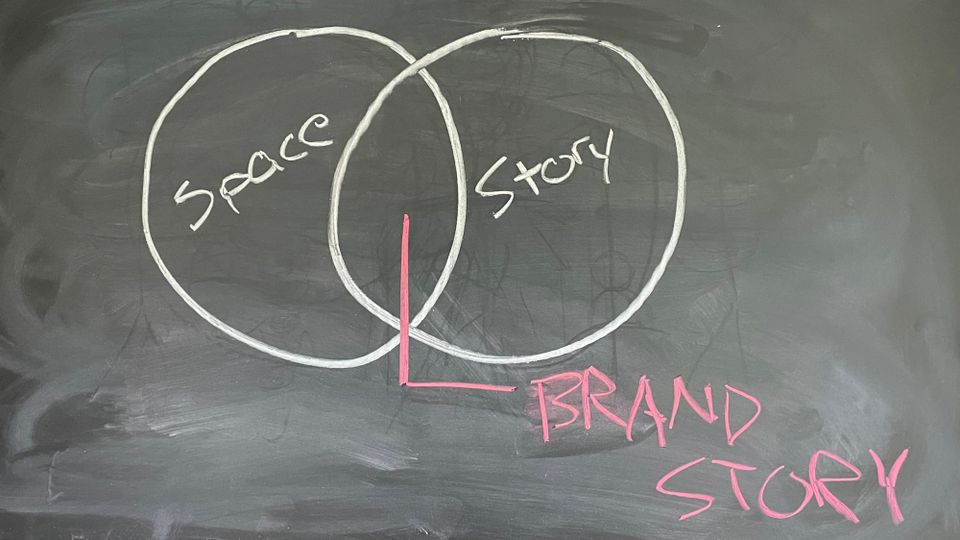
The reframe was simple. A brand is a collection of stories. The firm’s stories live inside the people who did the work. The marketing function is to surface those stories, not to invent new ones.
This reframe applies to every professional services firm. Your brand is not what your marketing team says. Your brand is the accumulated story of every project your team has delivered, told by the people who delivered it.
PASS THE MIC
The campaign concept we built was called “Every Space Has a Story.” The premise was that every project the firm had ever completed could be narrated by the people who worked on it, and those narrations were more valuable than any marketing copy a marketing team could write.
The mechanism was an in-studio shooting schedule. A dedicated space for filming inside the office. A consistent calendar so it became routine rather than special. Mondays in studio: new hires, project highlights, community projects. Wednesdays drone day. Thursday on-site shoots at completed projects.
The content output was not heroic videos with sweeping music and aspirational voiceovers. The output was simple. A junior architect on camera saying “Hi, I am [name], a junior architect at the firm, I work in our main office, I have been collaborating on a fire station project, and the story of this project is…”
That is the unit. A person, a project, a story. Two minutes long. No production value beyond clean audio and decent light.
The compound effect of doing this consistantly for two years is that the firm’s marketing channels fill with rich, specific, human stories that no competitor can replicate, because the competitor does not have those people, those projects, or that institutional knowledge.
The principle is universal. In any professional services business, the people closest to the work are the most credible storytellers. They know the specifics. They know the constraints. They know the moment the project turned. They know what the client said when it finally worked.
Marketing teams cannot manufacture that knowledge. Marketing teams can build the system that surfaces it.
WHY MOST FIRMS DON’T DO THIS
The reasons are predictable. None of them are good.
Employees are uncomfortable on camera. This is true the first three times. By the fifth shoot, most people are fine. By the tenth, they look forward to it. The discomfort is a transient training problem, not a structural barrier.
Leadership is afraid employees will say the wrong thing. This is real and it is solved with simple guardrails. A pre-shoot conversation about what the project was about. A list of things not to say (active client confidentiality, current contract specifics, internal politics). A review of footage before posting. The employee is not going off-script because there is no script. They are talking about a project they actually worked on.
The marketing team feels threatened. If the employees are the storytellers, what is the marketing team for? The marketing team is for building and running the system. Booking the shoots, editing the footage, distributing the content, measuring the performance, evolving the format. The marketing team becomes a content operations function rather than a content creation function. This is a higher-leverage role, not a lesser one.
The firm does not have a dedicated space for filming. Build one. A corner of the office. Decent light, decent backdrop, decent microphone. A few hundred dollars of equipment. The cost of not having it is years of stories that never get told.
The schedule is hard to maintain. Yes. This is the actual hard part. Cadence is the work. Once-a-month shoots produce nothing. Weekly shoots produce a content engine. The firm has to commit to the cadence or this does not function.
Leadership wants the content to be polished. Polished content is more expensive to produce, takes longer, gets fewer reps in, and feels less authentic. Resist the pull toward production value. The content that performs is specific, human, and slightly imperfect. The architect who fumbles the project name and laughs about it gets more engagement than the perfectly delivered corporate explainer.
The deepest reason firms do not do this is that it requires the leadership team to trust the people closest to the work to represent the firm. Many leadership teams do not trust their people that way. The cost of that distrust shows up as marketing that says nothing specific because the people who could say something specific are not allowed to talk.
WHAT IT LOOKS LIKE WHEN IT WORKS
The output of an “Every Space Has a Story” system, run consistently for two years, is meaningful and measurable.
The website becomes searchable. Every project page now has a video associated with it. The video has a transcript. The transcript is full of project-specific language. The site starts ranking for project types, sectors, regions, and challenges that competitors cannot rank for because their sites do not have that depth of project-specific content.
Recruiting changes. Candidates who watch the videos before interviewing have already met the team. They show up to interviews wanting to talk about the projects they saw. They self-select into a firm that values their voice. The candidates who do not want to be on camera filter out, which is also useful.
Sales conversations change. Prospects walk into pitch meetings having already watched five videos of similar projects. They know the firm. They know the team. The pitch becomes a conversation about a specific project they want to do, rather than a sales presentation about why they should hire this firm.
Internal culture changes. Employees see themselves on the company channels. They send the videos to their parents, their friends, their college network. The firm becomes something they are visibly part of, not just a company they work for. Retention improves.
The firm’s expertise becomes legible. Before the system, the expertise lived in people’s heads and in proposal documents that nobody outside the firm read. After the system, the expertise lives in a public library of project narratives that anybody can find. The firm becomes the firm that talks about education projects in Georgia, or county fire stations, or charter school architecture, because that is what its videos show.
This is not theoretical. The firm did this. The shift from generic professional services brand to story-rich professional services brand changed how the firm was perceived in the market and changed how the team thought about their own work.
This is what it looks like when a firm solves Story Not Internalized by the Team. The story stops being a marketing campaign and starts being a content engine the team owns.
WHAT THIS LOOKS LIKE FOR NONPROFITS
If you run a nonprofit at five to fifty million in giving, the same principle applies with sharper stakes. Your stories are mission stories. Your storytellers are program staff, beneficiaries, volunteers, donors, board members. Most nonprofits have program staff who could tell mission stories better than any communications team, and most nonprofits do not give them the tools, the schedule, or the permission to do it.
The build is the same. A dedicated space, a consistent cadence, simple production, a content operations function in the marketing or communications team. The output is staff and beneficiaries telling specific stories about specific moments of the mission, instead of communications copy describing the mission in abstract terms.
Donors give to specific stories. They do not give to mission statements. The nonprofits that build a story engine outperform the nonprofits that publish reports.
WHAT TO DO WITH THIS
This week, identify the three most active, comfortable communicators on your team. Not the executives. The mid-level people who actually do the work. A project manager. A senior associate. A program director. Whoever has the project knowledge and is willing to talk on camera.
Ask each one to record a two-minute video about a recent project. No script. Three prompts: who was the client and what did they need, what was the hardest part of the work, what was the moment the project turned. Have them record on their phone in their office. Post it.
Watch what happens. Watch how people respond. Watch what your team thinks about it. Watch whether other people on the team start asking when they get to record one.
If the response is positive, you have evidence to build the system. A weekly cadence. A dedicated space. A content operations team. Two years of consistent output.
If the response is negative, you have learned something about your firm’s relationship to its own people that is worth understanding before you spend money on more marketing campaigns.
Every space has a story. The people who built the space know the story. They are waiting to be asked.
Pass the mic.
So much respect.
Frequently Asked Questions
Q: Why does my firm’s marketing sound the same as every other firm in our industry? A: Because most professional services marketing is built around abstract values rather than specific project stories. The fix is to stop talking about who you are and start surfacing what your team has actually done. The people closest to the work have the specific, unrepeatable knowledge that no competitor can copy.
Q: How do I get my employees comfortable being on camera for content? A: The first three shoots are uncomfortable. By the fifth, most people are fine. Build the cadence first, accept early awkwardness, and watch the team grow into it. Comfort is a training problem, not a structural barrier.
Q: What kind of content schedule works for an employee storytelling program? A: Weekly cadence is the threshold. Once-a-month shoots produce nothing meaningful. A consistent schedule, like Monday in-studio shoots and Wednesday drone days, turns the program from a one-off campaign into infrastructure that compounds.
Q: Won’t my marketing team feel threatened if employees become the storytellers? A: They might at first. The reframe is that the marketing team becomes a content operations function instead of a content creation function. They book the shoots, edit the footage, distribute the content, and measure performance. That is a higher-leverage role than writing copy that nobody reads.
Q: Does this work for nonprofits or only for-profit professional services firms? A: It works for both. For nonprofits with $5M to $50M in giving, the storytellers are program staff, beneficiaries, volunteers, and board members. The build is identical: dedicated space, weekly cadence, simple production. Donors give to specific stories. They do not give to mission statements.